



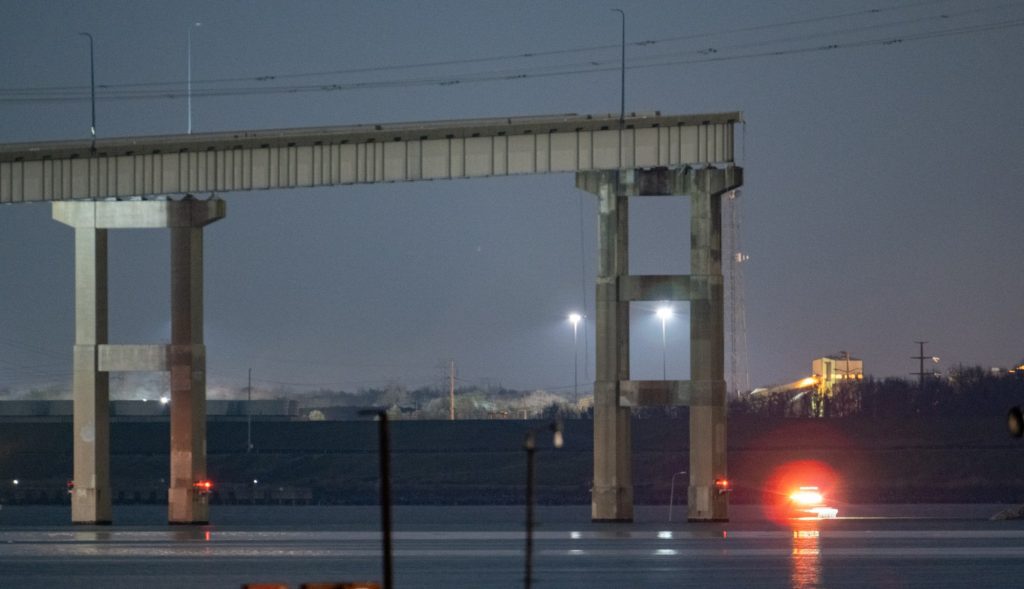
Engineers and bridge designers were asking questions on Tuesday about the safety of the structure following a catastrophic collapse of the Key Bridge. The Key Bridge suffered a devastating collapse overnight. A cargo container hit one of the bridge's support columns, causing most of the bridge and a road crew to fall into the Patapsco River.
According to Ian Firth, a British structural engineer and bridge designer, many similar bridges have barriers to reduce the impact of a vessel colliding with a pier, especially in busy shipping channels.
Ian Firth mentioned that protective installations include cable systems, pontoons, custom-destined caissons, and submerged islands, with one of the most common being "dolphins," which are circular sheet pile cells filled with material like sand or concrete.
The Sunshine Skyway bridge, which collapsed in 1980 after a freighter collided with a support beam, prompted engineers to deploy protective structures.
When the Sunshine Skyway was replaced, engineers included dolphins on artificial islands for protection.
While no artificial islands were visible near the Key Bridge's piers, protection was in place on a parallel system of transmission towers, including dolphins in the water.
In December, ShibataFenderTeam built transmission towers with dolphins in the water and covered the foundations and dolphins with sliding plates to protect them from potential water-traffic collisions.
Benjamin Schafer, a professor at Johns Hopkins University, suggested that the lack of protection at the Key Bridge may have contributed to the collapse.
SFT officials did not immediately respond to requests for comment on Tuesday.
While acknowledging that he was not familiar with all the specific details of the Key Bridge, Ian Firth believed that the protection of the bridge's pillars could have been stronger.
Ian Firth stated that a well-designed and located protection system should prevent large vessels from reaching critical bridge supports, but acknowledged that the narrowness of the channel might have made it difficult to deploy large dolphins without restricting the channel too much.
Setting up a system that can stop ships of this size would depend on several factors like the local land features, water depth, underwater ground conditions, environmental concerns, and so on. James Firth, a London-based professional who has worked on projects globally, mentioned that it would also be quite expensive.
Experts mention that dolphins come in various shapes, sizes, and levels of protection, often based on the cost involved.
A Baltimore Sun article from the day after the Tampa disaster in 1980 quoted the director of engineers for what was then called the state Toll Facilities Administration as saying the Key Bridge had a type of “concrete dolphins” at the time.
An official named Mike Snyder mentioned in the story that these dolphins were meant to steer ships away from the piers. Even if they couldn't completely divert a vessel, they might absorb enough of the ship’s force to make a collision more of a glancing blow by the time it hit the pier.
However, he pointed out that the bridge couldn't endure a direct impact from a large freighter and that, as of 1980, it wouldn't be financially practical to install such a system.
“Whatever unit got struck, that section would be knocked down,” he said.
Three months later, in August 1980, a freighter that lost power chipped a concrete piling on the bridge, according to a Sun article at the time. The piling was partially protected by a “concrete and wood collar,” but the accident did damage estimated at $500,000.