



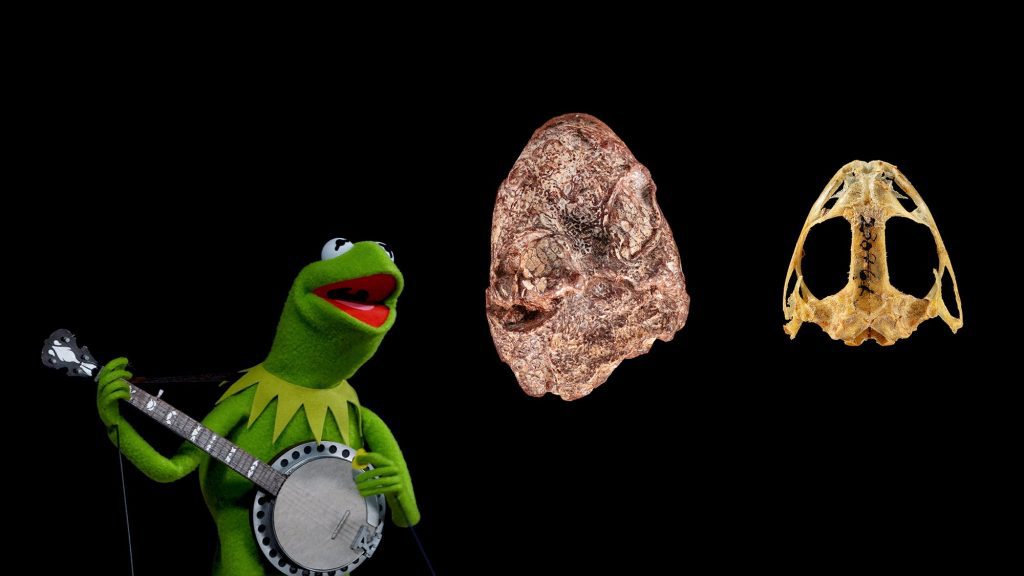
It’s not It's not easy being green, but a recently identified amphibian ancestor is gaining attention after many years stored tucked away in the Smithsonian’s National Fossil Collection in Washington DC. This new species is called Kermitops gratus, in tribute to famous amphibian Kermit the Frog. It inhabited the earth over 270 million years ago and its discovery is changing our understanding of amphibian evolution. The details are outlined in a report published March 21 in the Zoological Journal of the Linnean Society.
A stout salamander-like creature
Based on an inch-long skull fossil, scientists thought that Kermitops likely would have looked like a stout salamander. The fossil has large, oval-shaped eye sockets, similar to the distinctive eyes of the Muppet it is named after. Kermitops was probably a temnospondyl–part of a varied group of early amphibian relatives that lived for over 200 million years from the Carboniferous Period up to to the Triassic.
“It probably was a little more terrestrial than some other frogs and salamanders,” study co-author and Smithsonian vertebrate paleontologist Arjan Mann tells PopSci. “The ecosystems that would have inhabited probably marginal pond environments, similar areas to where you find amphibians living today.
“I don’t quite see the resemblance, but Miss Piggy and the other Muppets assured me it’s uncanny!”
Kermit the Frog
At times, Kermitops’ environment was potentially similar to the swamp where viewers first meet Kermit singing and strumming the banjo in 1979’s The Muppet Movie. This prehistoric ecosystem also saw large shifts in seasonal rainfall and dry spells, similar to the monsoons seen today in the Southwestern United States and Southeast Asia.
[Related: These pleasantly chunky salamanders were prevalent during the Cretaceous period.]
“That rainfall would really feed this ecosystem in pulses,” study co-author and George Washington University evolutionary biologist and PhD student Calvin So tells PopSci. “That’s what sustained animals like Kermitops and modern amphibians have some of the same or similar constraints.”
Paleontological patience
The fossil was originally found by the late Smithsonian paleontologist Nicholas Hotton III. Hotton made several research trips to dig for fossils from a group of rock outcrops in north central Texas called the Red Beds. These rust-colored rocks date back to more than 270 million years ago to the Permian Period and are full of the fossilized remains of ancient reptiles, amphibians, and even some precursors to modern mammals called sail-backed synapsids.
Hotton’s team collected so many fossils that they couldn’t study them all in close detail. This included a small proto-amphibian skull that they found in a rock layer called Clear Fork Formation in 1984–the same year The Muppets Take Manhattan was released. The skull was labeled as an early amphibian and spent decades before researchers could take a closer look. It caught Mann’s eye in 2021 when he was a postdoctoral paleontologist at the Smithsonian.
“It was easily identifiable as a taxa that that’s something new and different from anything we knew,” Mann tells PopSci.
A head that snaps
Mann and So worked together to determine what kind of prehistoric creature the fossil belonged to. It has a mix of traits that appeared different from the skulls of older tetrapods–the ancient ancestors of amphibians and current four-legged vertebrates. The region of the skull behind the animal’s eyes was also much shorter than its longer and curved snout. These skull proportions likely helped it quickly grab food like a modern day snapping turtle.
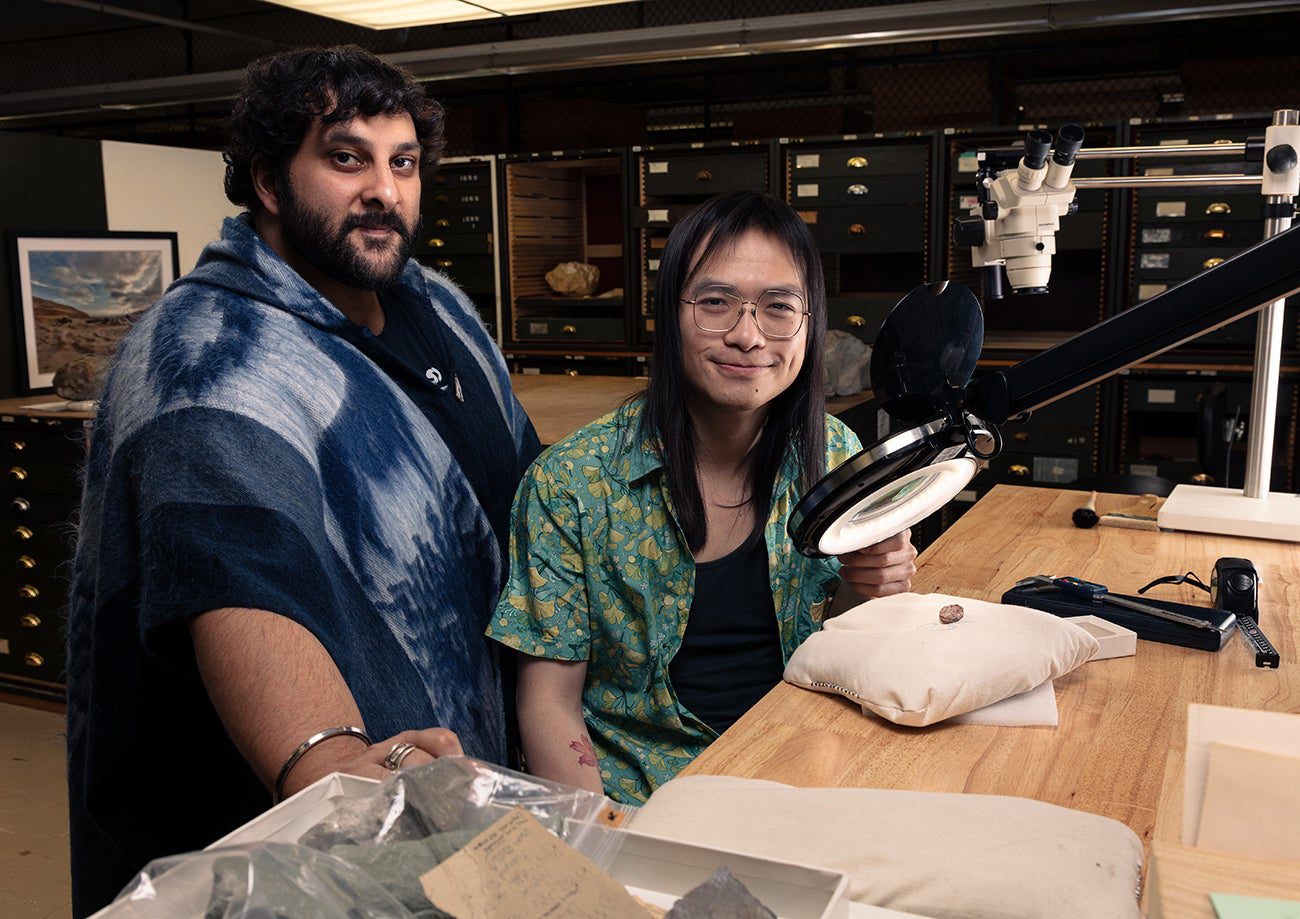
“It may have been predisposed for these rapid snapping movements,” says So. “Because of its small size, it was probably feeding on things smaller than itself, like insects, worms and vertebrates, but also potentially smaller amphibians.”
Since the skull had such unique features, the team concluded that it belonged to an entirely new genus they named Kermitops. It is a play on the amphibian’s wide-eyed face and is a combination of the words “Kermit” and the Greek suffix “-ops,” for face. The word Gratus is a representation of the team’s gratitude to Hotton and the rest of the team that originally unearthed the fossil so many years ago.
The team also hopes that naming it after the beloved frog who was created by puppeteer Jim Henson in 1955, can help get more people interested in the discoveries that scientists make using museum collections.
[Related: These legless, egg-laying amphibians secrete ‘milk’ from their butts.]
“There are so many implications for reaching a broader audience,” says So. “We don’t only want to inspire future generations of paleontologists, but we hope to expand what science is, from this very dedicated field to something that may potentially integrate with more creative and artistic things. “
In a statement sent to PopSci, Kermit the Frog wrote: “When the Smithsonian team approached me asking to name a newly-discovered amphibian species after me, I was truly honored… and a little puzzled. I don’t quite see the resemblance, but Miss Piggy and the other Muppets assured me it’s uncanny! Wait ‘til I tell my family in the swamp about our new great-great-great-great-great aunt or uncle–although we never got any gifts from them, so maybe they’re not that great.”
[Related: These spiky frog skulls look more like dinosaur fossils.]
Small fossil, big deal
Despite being such a tiny specimen, Kermitops is filling in some significant evolutionary gaps for amphibians. The early fossil record of amphibians and their ancestors is very fragmented, which makes it difficult for scientists to put together how frogs, salamanders, axolotls, and their kin evolved. Finding more early forms of amphibious life is essential for building out the early branches of the amphibian family tree.
“Amphibian evolution was believed to be sort of a linear pattern before, but fossils like Kermitops, kind of put a wrench in that by showing maybe this wasn’t as simple as we thought,” says Mann. “It might have been a process that occurred over many lineages at the same time. Paleontology is always more than just dinosaurs, and there are lots of cool evolutionary stories and mysteries still waiting to be answered.”