



Close Menu
    What's Hot

    Child mental health forum to be held in Norristown

    May 13, 2024

    GameStop's stock prices surged when Roaring Kitty made a comeback on social media

    May 13, 2024

    Van Jones criticized possible Trump VP candidates for avoiding 2024 election questions, saying it's like failing kindergarten

    May 13, 2024
    Facebook X (Twitter) Instagram Telegram
    Facebook X (Twitter) Instagram
    The Plaza JournalThe Plaza Journal
    Subscribe
    Saturday, May 23
    • Sports
      • American Football
      • Basketball
      • Baseball
      • Boxing
      • Cricket
      • Football
      • Hockey
      • Tennis
    • Politics

      John Dean believes the hush money case against Trump is very strong

      May 13, 2024

      “Cruel and unfeeling” Trump assistant boasts about causing innocent homeless people to be arrested

      May 13, 2024

      Only 5 percent of people mention January 6th as the most important memory from Trump's presidency: Survey

      May 13, 2024

      7 in 10 say they’ve given a lot of thought to election: Gallup

      May 13, 2024

      Trump: ‘Hannibal Lecter is a wonderful man’

      May 13, 2024
    • Technology
    • United States
    • United Kingdom
    • Business
    • Entertainment
    • Science
      1. Archaeology
      2. Anthropology
      3. Space
      4. Biology
      5. Ecology
      6. Geology
      7. Nanotechnology
      8. Neurology
      9. Paleontology
      10. Psychology
      11. Mathematics
      12. Geography
      13. Astrophysics
      14. Oceanography
      15. Physics
      Featured

      How perspiration and endurance helped humans become excellent runners and hunters

      Biology May 13, 20244 Mins Read
      Recent

      How perspiration and endurance helped humans become excellent runners and hunters

      May 13, 2024

      Amazing photos of colorful skies around the world as auroras shine in bright colors

      May 11, 2024

      Scotland has suddenly seen a large increase in mosquitoes

      May 10, 2024
    • Health
    Facebook X (Twitter) Instagram
    The Plaza JournalThe Plaza Journal
    Home»Science

    Satellite reveals 8000 years of human settlements

    By Bijoy DanielMarch 20, 2012 Science 4 Mins Read
    Share
    Facebook Twitter LinkedIn Pinterest Email

    Ancient human settlements have changed the landscape around where they live in such a way that today, 8000 years later, archaeologists can tell if an area was inhabited – using little more than images taken from a satellite.
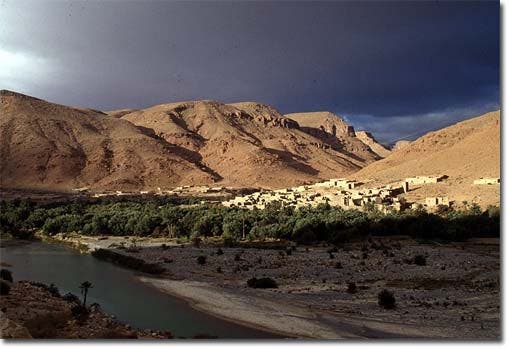
    Deep in the Middle East, beyond the impressive mounds of Earth which marked the bigger, known cities of the ancient Arabic times, lurk overlooked networks of small settlements that probably hold vital clue to understanding ancient civilizations. By combining spy-satellite photos obtained in the 1960s with modern multispectral images and digital maps of Earth’s surface, researchers have managed to create a new method of mapping large scale human settlements. The method was used to map approximately 14.000 settlement sites, spanning over a period of 8.000 years, in 23,000 square kilometres of northeastern Syria – and the results were published in the Proceedings of the National Academy of Sciences.

    “Traditional archaeology goes straight to the biggest features — the palaces or cities — but we tend to ignore the settlements at the other end of the social spectrum,” says Jason Ur, an archaeologist at Harvard University in Cambridge, Massachusetts, who is co-author of the study. “The people who migrated to cities came from somewhere; we have to put these people back on the map.”

    Such comprehensive maps of previously overlooked features promise to uncover long trends in migration and urban activity, which will give valuable information in truly understanding ancient Arabian civilizations – and not only.

    “This kind of innovative large-scale application is what remote sensing has been promising archaeology for some years now; it will certainly help us to focus our attention on the big picture,” says Graham Philip, an archaeologist at Durham University, UK.

    This method relies on the fact that human activity leaves a certain mark on the soil, creating the so-called anthrosols, which form from a higher levels of organic matter and have a finer texture and lighter appearance than undisturbed soil, which results in certain reflective properties noticeable by satellites. However, to capitalize on these properties, archaeologists had to be helped by Bjoern Menze, a research affiliate in computer science at the Massachusetts Institute of Technology in Cambridge, who used skills from his day job – identifying tumours in clinical images. He ‘trained’ the software to detect the specific wavelengths of known anthrosols, and this approach proved to be the key of the problem.

    “You could do this with the naked eye using Google Earth to look for sites, but this method takes the subjectivity out of it by defining spectral characteristics that bounce off of archaeological sites,” says Ur.
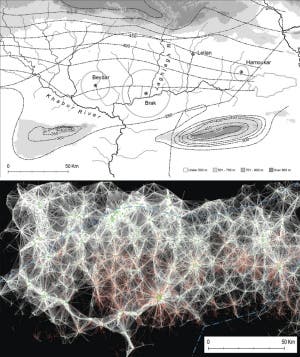
    The technique is already redefining a part of what we believed about ancient settlements, renewing speculation about the importance of water to city development. The study found that a large number of sites (even big ones) were located quite far away from rivers or areas of high precipitation.

    “The settlement known as Tell Brak, for example, is far too large for what one would expect at such a marginal position,” says Ur. “This is where things get interesting.”

    Jennifer Pournelle, a landscape archaeologist from the University of South Carolina in Columbia, agrees:

    “These findings validate hypotheses I’ve introduced in southern Iraq — namely that irrigation is an after-effect of urbanization,” she says. “It’s not what enables a city to develop; it’s what keeps them going after soil moisture dries up.”

    Pournelle says she hopes to apply the method on an even larger scale, in an attempt to decipher how these inhabited areas worked, especially when they are remote, far away from water, or difficult to access because of local conflicts.

    Via Nature

    Anthrosols Archaeology Landscape Archaeology Satellite Imaigng Teledetection
    Bijoy Daniel

    Keep Reading

    How perspiration and endurance helped humans become excellent runners and hunters

    Amazing photos of colorful skies around the world as auroras shine in bright colors

    Scotland has suddenly seen a large increase in mosquitoes

    ‘Buoyant’ magma offers clues about the power of volcanoes

    Add A Comment
    Leave A Reply Cancel Reply

    Must Read
    Latest Posts

    Child mental health forum to be held in Norristown

    May 13, 2024

    GameStop's stock prices surged when Roaring Kitty made a comeback on social media

    May 13, 2024

    Van Jones criticized possible Trump VP candidates for avoiding 2024 election questions, saying it's like failing kindergarten

    May 13, 2024

    Chicken fat supercapacitors may be able to store future green energy

    May 13, 2024

    Most students at prestigious universities believe that there is an issue with antisemitism, as per a survey conducted by U.S. News & World Report

    May 13, 2024
    The Plaza Journal White Logo
    X-twitter Facebook Google Pinterest Telegram

    News

    • World
    • US Politics
    • EU Politics
    • Business
    • Opinions
    • Connections
    • Science

    Company

    • Information
    • Advertising
    • Classified Ads
    • Contact Info
    • Do Not Sell Data
    • GDPR Policy
    • Media Kits

    The Plaza Journal

    • Contact Us
    • Subscription
    • Submit an Anonymous Tip
    • Newsletters
    • Sponsored News
    • Advertise With Us
    • Privacy Notice

    Keep updated

    Get the latest creative news from FooBar about art, design and business.

    Copyright © 2026 The Plaza Journal. All rights reserved.
    • Privacy Policy
    • Terms of Use
    • Cookie Policy
    • Accessibility

    Type above and press Enter to search. Press Esc to cancel.