



Pottery was not widely known in Australia in the past, despite established pottery practices in nearby Papua New Guinea and the western Pacific islands. The absence of ancient Indigenous pottery in Australia has puzzled researchers for a long time.
In the last 400 years, pottery from southeast Asia showed up in the northern part of Australia, linked to the activities of Makassan people from Sulawesi (primarily trepanging, or collecting sea cucumbers). Older pottery in Australia is only known from the Torres Strait near the Papua New Guinea coast, where a small number of pottery fragments have been reported, mostly dating back about 1700 years.
Why haven't they found any evidence of early pottery use by Aboriginal people? Various explanations have been suggested, including the idea that archaeologists simply weren't putting in enough effort. Well now, we've found some.
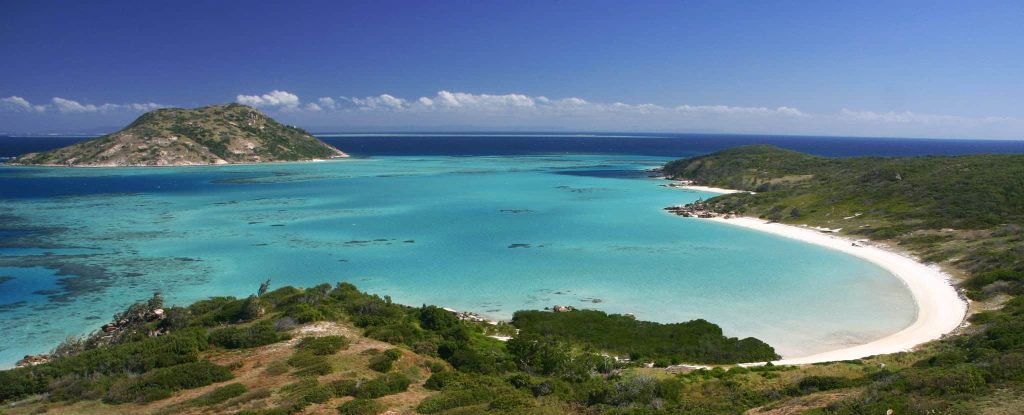
In new research, we present the oldest securely dated ceramics discovered in Australia from archaeological digs on Jiigurru (in the Lizard Island group) on the northern Great Barrier Reef located 600km south of Torres Strait. Our analysis indicates the pottery was made locally over 1800 years ago.
Discovering pottery at Jiigurru
In 2006, several fragments of pottery were discovered in Blue Lagoon on Jiigurru, 33km off mainland Cape York Peninsula.
Finding pottery at Jiigurru raised important questions. How old was it? Was it made by local Aboriginal communities? Or was it traded from somewhere else? If so, where did it come from? Was it from a European shipwreck? Or was it made by the famous Lapita people who colonised the islands of the southwest Pacific?
Our team dug up several more pottery fragments from Blue Lagoon in 2009, 2010 and 2012.
Initial analyses showed most of the pottery was made from local materials. However, despite extensive work, our efforts to determine the age of this pottery were inconclusive, and we were no closer to figuring out its age or origin.
In 2013 we returned to Jiigurru to excavate a shell midden on a headland near where the Blue Lagoon pottery was discovered. A shell midden represents a place where people lived, containing food remains (shells, bones), campfire charcoal, and abandoned stone tools.
Radiocarbon dating showed people started camping at this place around 4,000 years ago, making it the oldest site then known at Jiigurru. But no pottery was found.
A wider search
By 2016 the team had hit a wall in investigating the few pottery fragments we had. Instead, working in collaboration with Traditional Owners, we shifted the research focus to the extraordinary Indigenous history of the entire Jiigurru and began surveying all the islands.
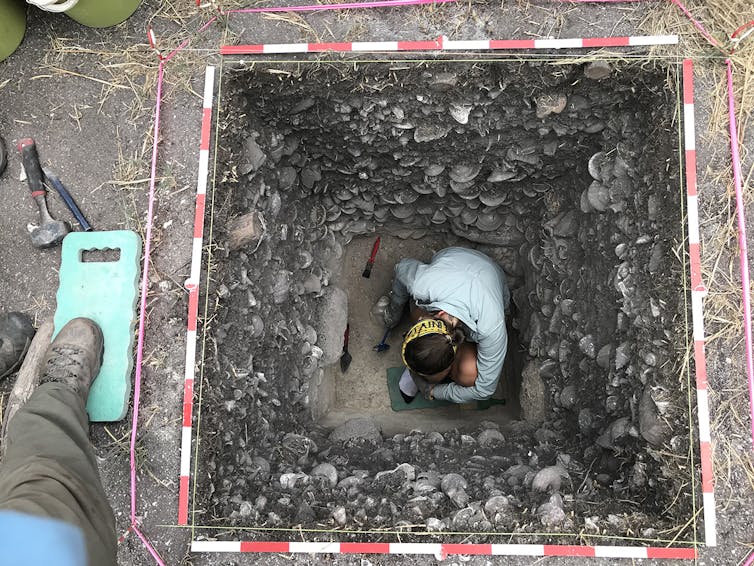
In 2017 we began excavating a large shell midden at Jiigurru identified during the surveys.
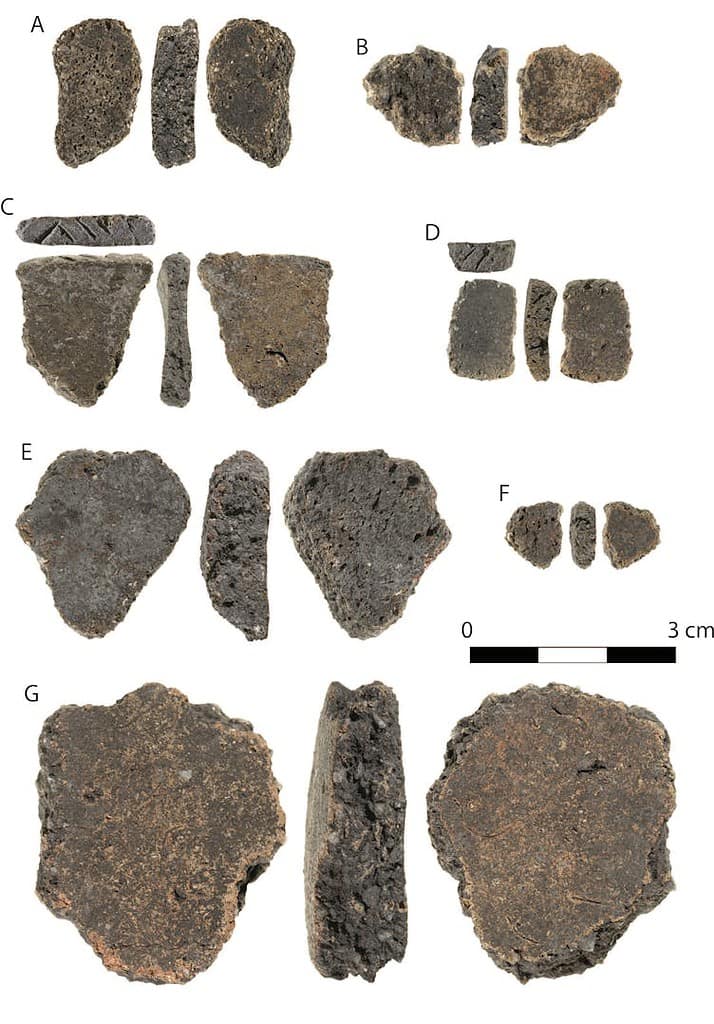
To our surprise, around 40cm below the surface we started finding pottery fragments among the shells in the excavation. We knew this was significant. We carefully bagged each piece of pottery, mapped where each fragment came from, and kept digging.
The pottery stopped at around 80cm depth, with a total of 82 pieces. Most are very small, with an average length of only 18 millimeters. The pottery collection includes pieces from the rim and neck, and some of it is decorated with pigment and incised lines.
The oldest pottery
But we had another surprise waiting for us.
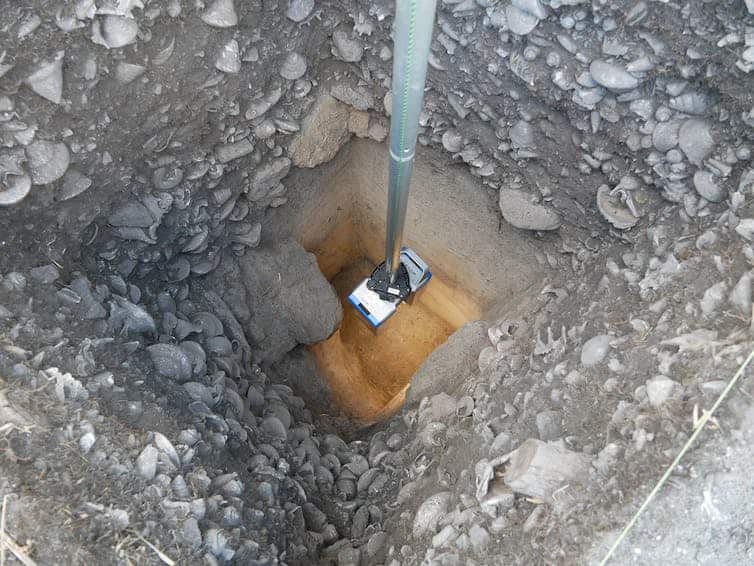
The deepest cultural material was discovered almost two meters below the surface, in levels that we radiocarbon dated to about 6,500 years ago. This is the earliest evidence for offshore island use on the northern Great Barrier Reef.
The reef shells eaten and discarded in these lowest levels were buried so quickly that they still have color on their surfaces. Archaeological sites of this depth and age are rare anywhere around the Australian coast.
Dating of charcoal and shells found near the pottery shows that it is between 2,950 and 1,815 years old, making it the earliest securely dated pottery ever found in Australia. Analysis of the clays and tempers shows that all of the pottery was likely made on Jiigurru.
What does it tell us that we didn’t already know?
The findings are clear evidence that Aboriginal people made and used pottery thousands of years ago.
The archaeological evidence does not indicate outsiders bringing pottery directly to Jiigurru. Instead, it shows that Cape York First Nations communities were deeply involved in ancient maritime networks, connecting them with peoples, knowledges and technologies across the Coral Sea region, including the knowledge of how to make pottery.
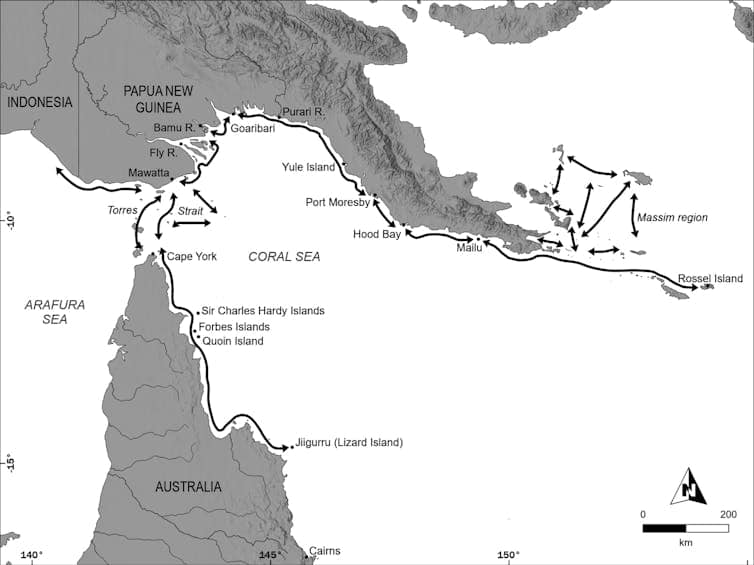
They were not isolated or geographically constrained, as once thought.
The results also show that Aboriginal communities had advanced watercraft and navigational skills in using their Sea Country estates more than 6,000 years ago.
What else don’t we know?
The Jiigurru pottery gives us new insight into Australia’s history and the international reach of First Nations communities thousands of years before British invasion in 1788.
Very little research has been conducted in the area. We believe it is highly unlikely that Jiigurru holds the only secrets to our country’s populated past. What other cultural and historical surprises await to be found?
Sean Ulm, Director, ARC Centre of Excellence for Indigenous and Environmental Histories and Futures, James Cook University; Ian J. McNiven, Professor of Indigenous Archaeology; Chief Investigator, ARC Centre of Excellence for Australian Biodiversity & Heritage, Monash University, and Kenneth McLean, Director, Walmbaar Aboriginal Corporation, Indigenous Knowledge
This article is republished from The Conversation under a Creative Commons license. Read the original article.