




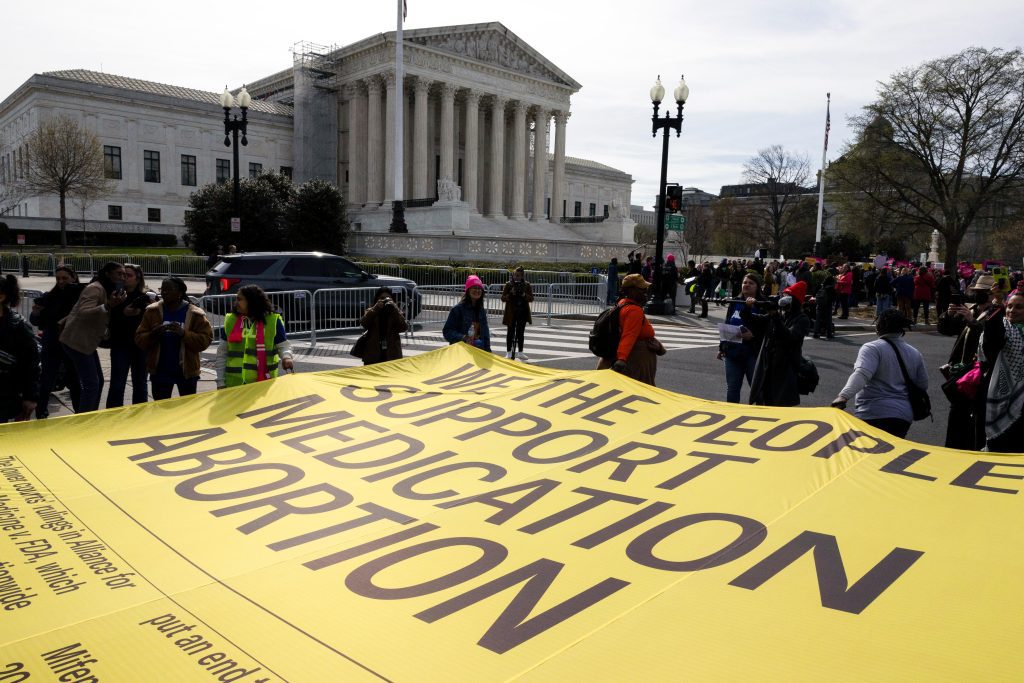
By Matthew Perrone, Amanda Seitz and Christine Fernando, Associated Press
WASHINGTON (AP) — Justices at the U.S. Supreme Court on Tuesday seemed hesitant to restrict Americans’ access to the abortion pill mifepristone , in a case that could significantly impact the Food and Drug Administration’s supervision of numerous medications.It’s the first time the court has taken an abortion-related case since most of the current justices invalidated the constitutional right to abortion in 2022
A group of anti-abortion doctors had urged the court to limit access to mifepristone and to restrict its use during pregnancy. Notable points from the debates: ABORTION PILL SAFETY SCRUTINY The FDA authorized mifepristone in 2000 as a secure and effective method to terminate early pregnancies.
. Last year, it was used in more than six in 10 of the abortions in the U.S.
The main argument of the conservative group contesting mifepristone is that the Food and Drug Administration ignored serious issues with the drug when it relaxed restrictions, such as allowing it to be delivered by mail in 2021.
Erin Hawley, who represented the doctors and group suing the agency, contended that the FDA “did not consider or clarify… its widespread removal of protections” for the pill.
But the FDA has long argued that its decision to eliminate in-person appointments to obtain mifepristone, among other requirements, came after 20 years of monitoring its safety. During that time, the agency examined numerous studies involving thousands of women, in which severe issues — including hospitalization — occurred less than 0.3% of the time. Hawley noted that the FDA’s own prescription label mentions that 2.9% to 4.6% of women taking the drug visit the emergency room. However, Solicitor General Elizabeth Prelogar referenced studies indicating that half of the women who go to the emergency room do not receive any treatment at all.“Many women might go because they’re experiencing heavy bleeding, which resembles a miscarriage, and they might just need to know whether or not they’re having a complication,” Prelogar said.
Because of the highly technical nature of evaluating drugs, courts have traditionally deferred to the FDA’s scientific judgments on drug safety and effectiveness.
Ketanji Brown Jackson pressed Hawley on the implications of questioning the agency’s regulators.
“So what deference do we owe them at all with respect to their assessment that these studies establish what it is that they say they do about safety and efficacy?”
HOW STRICT THE MEASURES SHOULD BE
Hawley faced inquiries as she argued for a nationwide rule limiting the use of mifepristone.
She was frequently interrupted by Justice Neil Gorsuch
Justice , who expressed objections to such extensive injunctions. The case “seems like a prime example of turning what could be a small lawsuit into a nationwide legislative assembly on an FDA rule or any other federal government action,” said Gorsuch.
Normally when a court issues an injunction about a government policy, it only applies to the individuals or groups involved in the case. However, in recent years, a growing number of justices on lower courts have issued “universal injunctions,” blocking federal regulations.
Gorsuch mentioned that there have been about 60 such rulings in the last four years.
Chief Justice John Roberts
also appeared doubtful that a ruling reversing the FDA’s scientific judgments was necessary. “Why can’t the court specify that this relief runs to precisely the parties before the court as opposed to looking to the agency in general and saying, ‘Agency, you can’t do this anywhere?’”RIGHT TO SUE
The Biden administration argued that the plaintiffs — a group of anti-abortion doctors — didn’t have the right to challenge the FDA’s approval of mifepristone.
The doctors who brought the suit argued that they might have to treat emergency room patients who experience serious complications from mifepristone.
But Solicitor General Elizabeth Prelogar told the court that the doctors don’t have to prescribe mifepristone and they can abstain from treating patients who have taken the pill if they oppose abortion.
“They don’t prescribe mifepristone,” Prelogar said. “They don’t take mifepristone, obviously. The FDA is not requiring them to do or refrain from doing anything. They aren’t required to treat women who take mifepristone.” Justice Samuel Alito, however, repeatedly pressed the government on who did have the right to sue over FDA’s decisions.
“Is there anybody who can sue and get a judicial ruling on whether what FDA did was lawful?” Alito, who wrote the 2022 ruling that overturned Roe v. Wade, asked.
REAL-LIFE EXAMPLES, PLEASE
Several justices pressed Hawley to provide real-life examples of doctors who oppose abortion being forced to treat patients who had suffered from abortion pill complications.
They also took issue with how many hypothetical problems Hawley raised in her argument against the FDA’s loosening of abortion pill restrictions.
“I don’t want to hypothesize,” Jackson said to Hawley, asking her to provide an example of a doctor who was unable to object to providing an abortion.
At one point, Justice
Amy Coney Barrett
also questioned an example one of the doctors provided of a colleague who had to perform a “dilation and curettage” procedure on a patient with complications. Barrett pointed out that those procedures are not just performed in cases of abortions but for miscarriages as well.
Some of the justices also pointed out that doctors are already protected from performing abortions when they don’t want to by voicing conscience objection.
Brett Kavanaugh
raised that point early on: “Under federal law, no doctors can be forced against their consciences to perform or assist in an abortion, correct?”
MORE DRUGS AT RISK
The FDA is the government agency responsible for assessing the safety of drugs and approving their sale in the United States.
It initially approved mifepristone in 2000. In 2016, FDA said it could be prescribed up to 10 weeks of pregnancy and allowed nurses and other medical professionals to prescribe. It allowed sales through the mail in 2021.
Justice Jessica Ellsworth, an attorney representing the New York-based Danco Laboratories, which makes mifepristone, asked the justices to consider how the case could upend the country’s entire pharmaceutical regulatory structure. She believes the court should carefully consider the potential problems that could arise if agencies begin taking action based on responsibilities that Congress has assigned to other agencies, she stated.
U.S. District Judge
Matthew Kacsmaryk’s decision last year was the first time a court had ever ordered the agency to withdraw its approval of a drug. Nearly 300 biotech and pharmaceutical company leaders criticized the ruling in a letter, saying it undermines Congress’ authority given to the FDA to approve and regulate drugs. They argued that if justices can unilaterally reverse drug approvals, it puts any medicine at risk. Fernando reported from Chicago.
U.S. Supreme Court justices seemed unwilling to restrict Americans’ access to the abortion pill mifepristone.
Jessica Ellsworth, an attorney representing the New York-based Danco Laboratories, which makes mifepristone, asked the justices to consider how the case could upend the country’s entire pharmaceutical regulatory structure.
“I think this court should think hard about the mischief it would invite if it allowed agencies to start taking action based on statutory responsibilities that Congress has assigned to other agencies,” she said.
U.S. District Judge Matthew Kacsmaryk’s decision last year marked the first time a court has ever ordered the agency to withdraw the approval of a drug. An open letter signed by nearly 300 biotech and pharmaceutical company leaders last year slammed the ruling as undermining Congress’ delegated authority to the FDA to approve and regulate drugs. If justices can unilaterally overturn drug approvals, they said “any medicine is at risk.”
Fernando reported from Chicago.