



This article was originally featured on Hakai Magazine,
In the ancient Mediterranean, Corinth was a strong economic center. Positioned on a narrow isthmus—a natural bottleneck between north and south—the city managed trade between northern Greece and the Peloponnese peninsula. Surrounded by well-protected bays on both sides, Corinth also served as a convenient link between the Aegean and Ionian Seas.
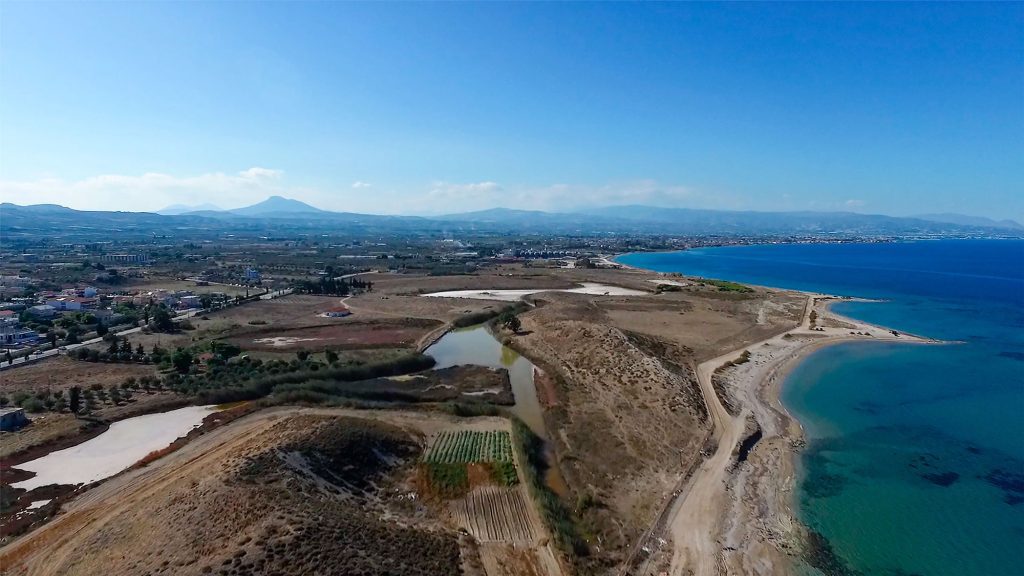
The primary harbor of the city, situated along the Gulf of Corinth, was the biggest port in ancient Greece. Previous research by archaeologists who studied gravesites and historical documents indicated that merchants set sail from the port, called Lechaion, over 2,600 years ago, in the 7th century BCE. They likely carried pottery, perfume, food, and fabrics to trade across the region.
But a recent discovery—five lumps of brown coal and a helping of ancient lead pollution—has pushed the history of this pivotal port back by at least 500 years, making it one of the earliest active ports in Europe. The revised history stems from an international research effort that’s been surveying the ancient harbor since 2013.
Using hand augers and mechanical drills, French geoarchaeologist Antoine Chabrol of Sorbonne University in France and his colleagues carefully collected cylinders of sediment from the inner harbor, where boats would have pulled upriver to anchor. Analyzing the mud cores, they found a sudden spike in lead levels less than three meters deep. The shift is so sharp and sustained that it could only have been caused by human activity on the riverbanks, says Chabrol.
Lead pollution comes from smelting, mining, and metalwork, and the scientists dated the pollution in the port to as early as 1381 BCE—3,405 years ago—during the Bronze Age.
The five chunks of brown coal, each no bigger than a matchbox, add further evidence of the port’s antiquity. These fragments are a specific kind of coal called lignite, and the pieces collected from the harbor’s sediment date to as early as 1122 BCE. The nearest known source of lignite is more than 50 kilometers away, suggesting merchants were importing the fossil fuel nuggets to stoke their harborside furnaces by the 12th century BCE.
Bronze Age ships might have paddled from port carrying urns of olive oil, bulk bins of fruit, and narrow-necked jars of wine to Crete, Cyprus, and beyond. But so far, while the team has found convincing evidence of Bronze Age activity in Corinth’s port, they’ve yet to find pieces of the actual port from this era. The physical evidence found at the site so far—including stone piers, wooden pillars, and a possible lighthouse—dates to the first century CE or later, during the Roman period.
But even without physical Bronze Age structures, the findings show that Corinth’s port was used consistently for nearly 2,600 years. From the 13th century BCE to the 13th century CE, Mycenaean, Phoenician, Roman, and Byzantine ships would have sailed from this strategic location.
“You can detect their presence in one single site,” says Panagiotis Athanasopoulos, an archaeologist at Greece’s Danish Institute at Athens and a collaborator on the project. “It’s like the very essence of historical continuity.”
Surprisingly, though, even this updated age might be a low estimate. Archaeologists have previously discovered proof of people journeying through Corinth over 8,000 years ago, as well as containers from a later Stone Age culture that resided to the northwest, along the Adriatic Sea. Bjørn Lovén, co-director of the Lechaion Harbour Project and coauthor of the new paper, says this implies Corinth’s sea trade network may go even further back in time.
Nafsika Andriopoulou, a geoarchaeologist at the Foundation for Research and Technology–Hellas’ Institute for Mediterranean Studies in Greece who was not involved in the study, says a broader analysis of what metals might be in the soil could help fill in even more details. For example, tracking other metals—such as copper, the main component of bronze—could tell geoarchaeologists even more about the port’s early uses. Similar sampling in nearby locations could even help reveal ancient trading routes, Andriopoulou adds.
The team will continue their work during the summer of 2024, looking for more clues of ancient commerce and bringing renewed activity to this long-bustling port.
This article first appeared in Hakai Magazine and is republished here with permission.