



Let me introduce you to one of the most interesting animals you’ve probably never heard about — or rather, make that two. Let’s take a brief dive into the world of two giant jellyfish.
The Nomura Jellyfish
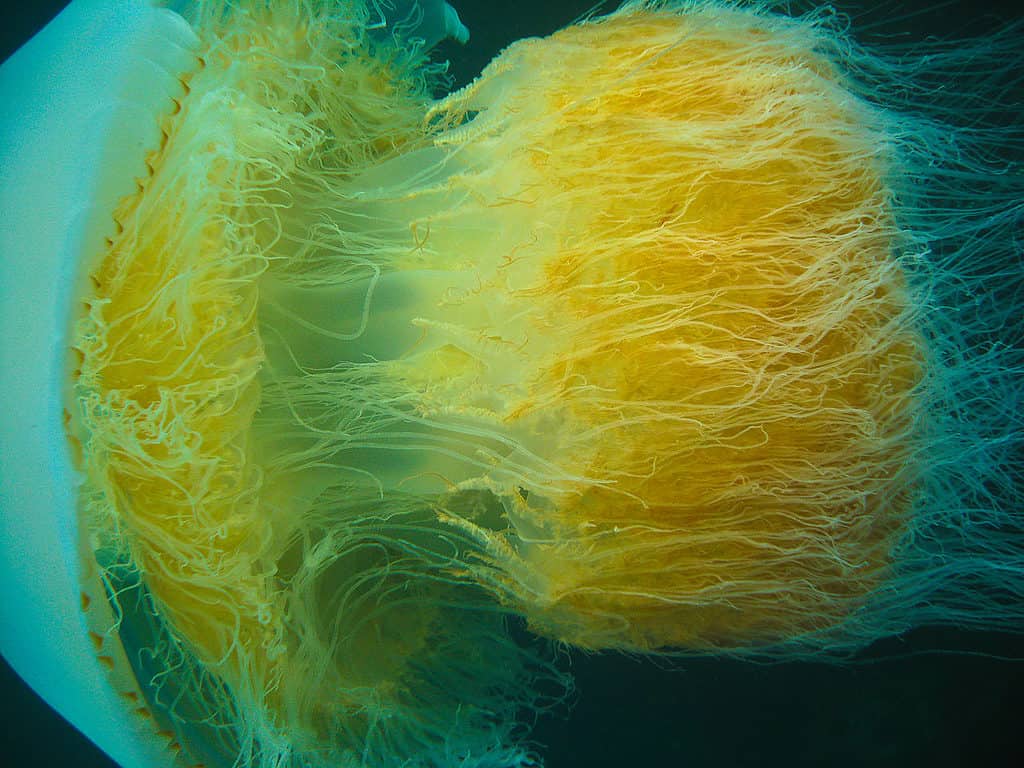
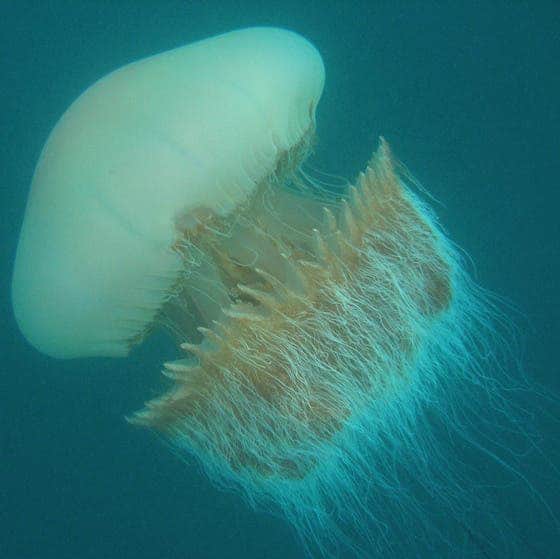
Nomura Jellyfish are a large species of jellyfish that can grow up to over 2 meters (6.5 feet) in diameter and can weigh well over 200 kilograms. They spawn in the seas between China and Japan, and from time to time, they give authorities in Japan some big headaches as they’ve been invading the Japanese shores for several years now.
Ironically, their population blooms, which appear to be becoming more common in the past 20 years, may be caused by human activity: global heating, overfishing, and the disturbance of the sediments which their polyps need are all causes that could be exacerbating population blooms.
Nomura jellyfish have become such a problem that a committee has been formed just for them, and researchers have been trying to promote them as a novel food. Students in Obama, Fukui (Japan) have managed to turn them into a sort of tofu, and they also managed to extract collagen, which is beneficial for the skin.
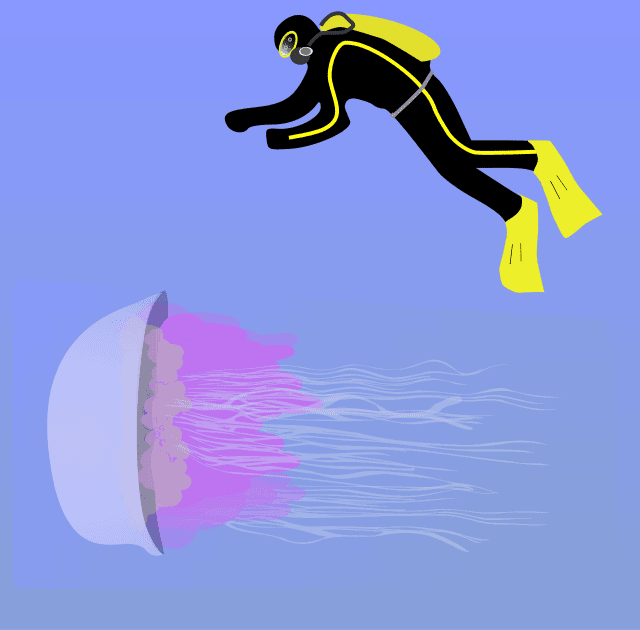
But size isn’t the only thing that makes the Nomura Jellyfish so special. They have a remarkable and complex life cycle, starting out as larvae, and then reaching stages called polyp, ephyrae, and medusa. Females carry their fertilized eggs in their own tentacles until they grow as larvae — and when the larvae are big enough, the females deposit them on a hard surface, where they grow into polyps. The polyps reproduce asexually, creating multiple clones of itself and eventually, stacks of ephyrae. Eventually, the stacks break off, and the medusa-stage jellyfish go on to become full-grown individuals.
Unsurprisingly given its size, the Nomura Jellyfish can also deliver a pretty dangerous venomous sting. Although it’s not as bad as the sting of other, smaller jellyfish, it can be quite painful to humans, and in extreme cases, even fatal.
The jellyfish eats plankton across all stages of its life, but when it grows big, it can even feed on some fish — and it has few natural predators. In just 6 months, it can grow from the size of a grain of rice to greater than 6 ft (1.8 m) wide.
So what caused this species to grow so large, even 100 times bigger than the average jellyfish? Well, its genetics and lack of predators obviously play a role, but in recent years, population blooms of particularly large individuals seem to be on the riseScientists have been able to come up with a few theories as to why this happens, and there’s a big possibility that all these theories work together:
- China’s big dam, the Three Gorges Dam on the Yangtze river is the biggest hydroelectric project. It also increased the amount of phosphorus and nitrogen in the waters off China, which is just what the Nomura jellyfish look for in a breeding ground.
- It is possible that the waters have been enriched in nutrients due to the activity of farms.
- The third theory is again linked with Chinese activity, especially with the development of ports and harbors, which are structures the larvae attach themselves.
- It could be that due to global warming the waters are heating and the waters are becoming more acidic, making it a better environment for jellyfish.
- The last theory is that China has overfished their waters and eliminated the predators that fed on the larvae.
It’s notable that not only does each jellyfish appear to be larger, but their range has increased as well.
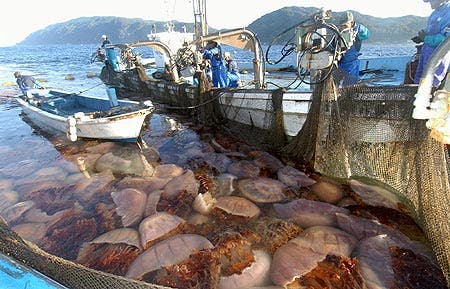
Even with the full help of the government, the Japanese have found it very hard to come to terms with these giants. Of course they aren’t immortal, but the problem is that whenever they feel under attack or threatened, they release billions of sperm or eggs which attach to corals or rocks and when conditions are favorable, they detach and grow into more jellyfish.
Lion’s mane jellyfish
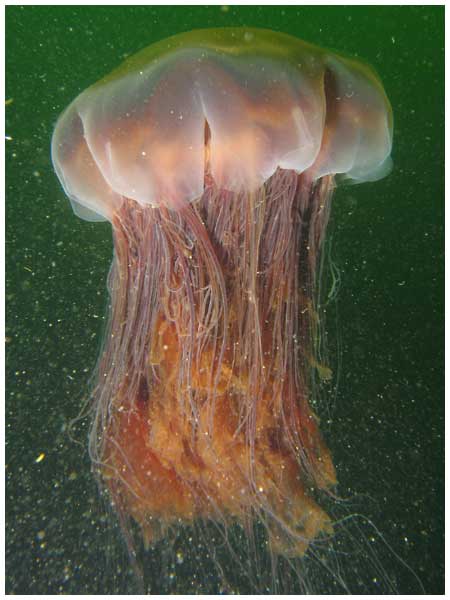
Jellyfish have been around for almost 700 million years, making them older than the dinosaurs. They are very simple yet efficient creatures, possessing no bones or cartilage, no blood, no heart, and also no brain! As a matter of fact, they are made up of 95% water. Sure, you can call that ‘simple’ or ‘brainless’, but it is pretty efficient.
To make them even more interesting, the lion’s mane jellyfish may just be the longest animal in the world. In 1870, off the shores of Massachusetts Bay, locals found a washed-up specimen that had a diameter of 2.3 meters, and its tentacles were 36.5 meters long, longer than a blue whale!
In fact, in 2010, up to 150 beachgoers in New Hampshire, USA, were stung by broken-up Lion’s mane jellyfish remains — and scientists assumed this was caused by a single specimen.
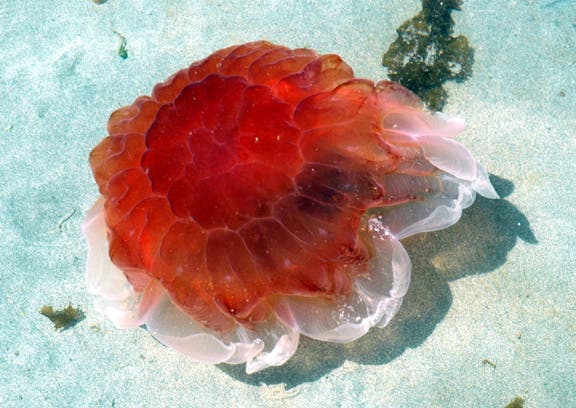
The tentacles are covered with millions of stinging capsules contained within the cells from the tentacles. This jelly, like many others, is a predator and captures its prey with the venom from the capsules. Its venom is very powerful and could be fatal to humans, but in most cases, it’s not. It also lives in very cold waters, even in the arctic areas, and cannot cope with warmer waters so don’t expect to meet them when you go swimming anytime soon.
Oh, I forgot to mention that this jellyfish (popularized in one of Sherlock Holmes’ original adventures) frequently grows over 2 meters in bell diameter and 30 meters in length, at the end of each summer. Fortunately, by that time, they are rather uncommon.
Ultimately, these large, alien-like creatures inhabit the same Earth we do — they’re travelers on the same space rock as us. As off-putting and bizarre as they may seem, their existence is not to be feared. Instead, we should strive to understand and cherish the diversity of life on Earth. After all, that’s what makes it so special.