




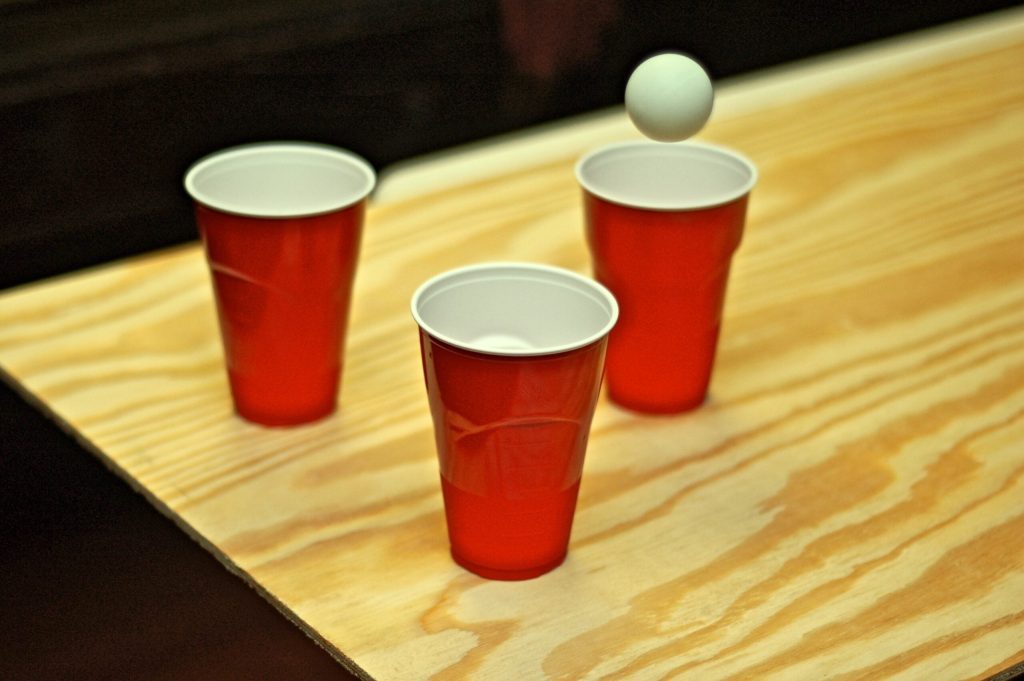
Beer pong samples
Beer pong (or Beirut, depending on where you’re from) is an American college staple right up there with tray-sledding and making microwavable ramen at 3 A.M. Aficionados agonize over decisions about where to place cups, the arc of their throws, who to choose as a teammate, and when to use that one re-rack.
The one thing they try not to think about is how much gross stuff they’re ingesting during play.
The brave journalists at Popular Science, along with the valiant scientists of Rockefeller University, tackled this question head-on. We’ve got some answers for you. And they’re pretty gross.
If you’ve never played, the primary objective of beer pong is to shoot ping pong balls into beer-filled cups on the other side of the table (the not-so-secret secondary objective is to get drunk). Two teams, each of two people, arrange six cups in rows of three, two, and one away from the edge of the table. The cups are about a third of the way filled with beer. There’s a water cup off to the side of the beer-filled cups. Each member of one team will try to shoot a ping pong ball into one of the cups on the opposite side of the table. If they succeed, their opponents have to drink the cup into which they sank the ball. Either way, after each round, the opposing team retrieves the ping pong balls from wherever they were thrown, dips them in the water cup to remove any visible grime, and aims to do the same thing on the other side.
Our intrepid research team sought to figure out how the microbes populating these various surfaces changed from the beginning to the end of the game. Our thought was that the ping pong ball, which invariably rolls around the floor before making its way into beer cups, might be transferring microbes from those places into the beer (and by extension, into players’ mouths).

Playing beer pong
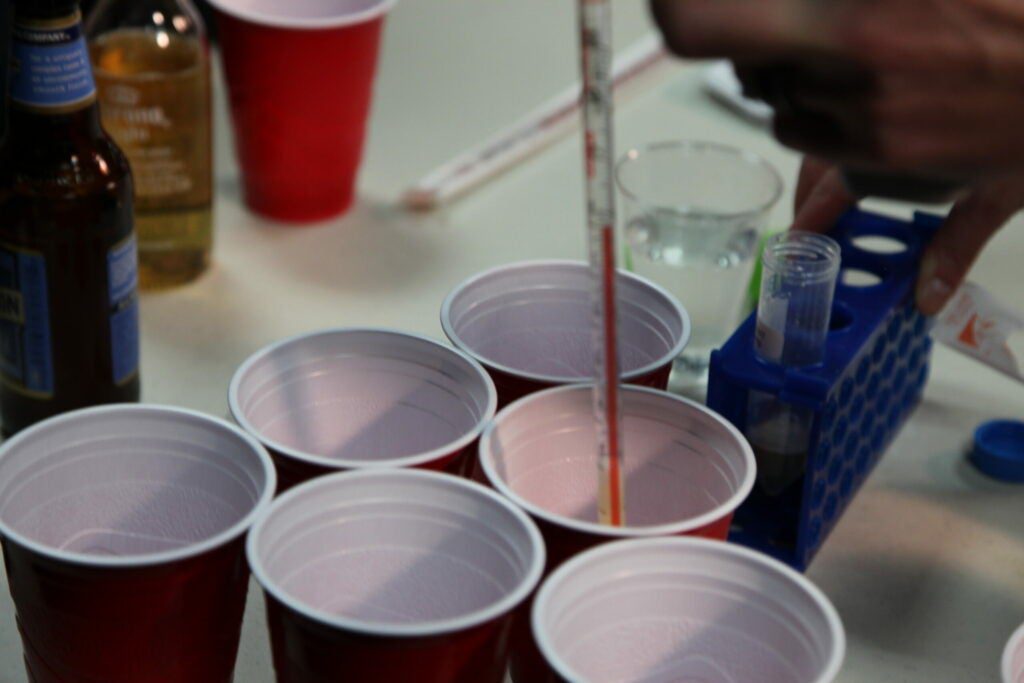
Before playing our super-scientific beer pong game, we donned plastic gloves and took swabs from the table, floor, rims of cups, and ping pong ball. The swabs would take provide samples of the bacteria on each of these surfaces, giving us a baseline for the microbes on each before play. The Rockefeller microbiologists took samples of the beer and of the water from the water cups.
Then we played a game of beer pong, scientists versus journalists. Research is hard work.
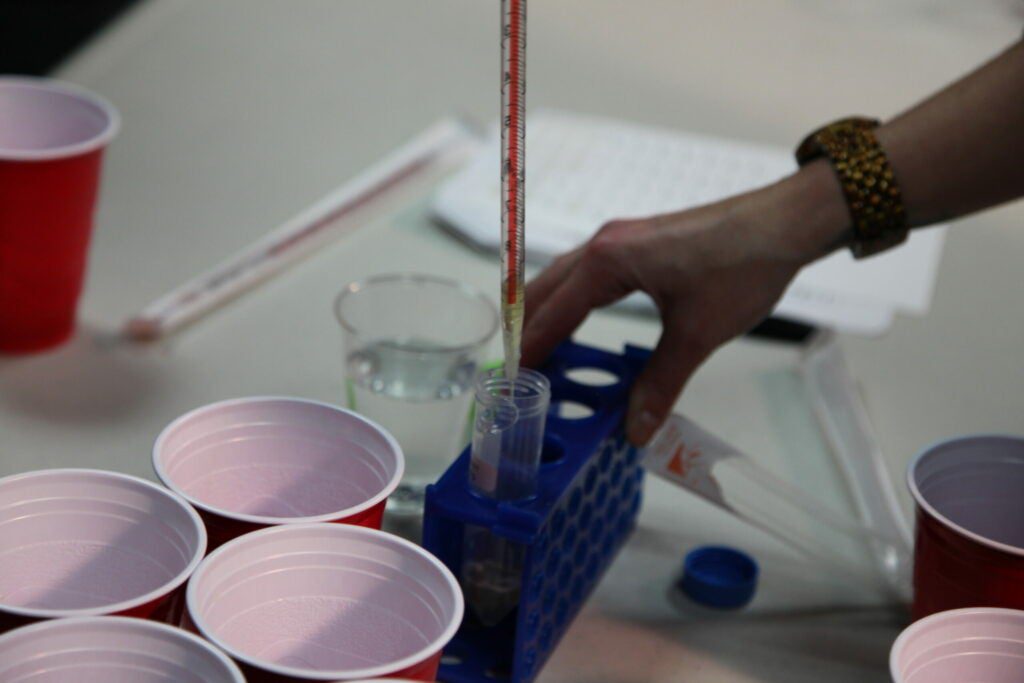
Each time someone sunk a ball, the designated person would take a sip, then the scientist would collect a sample of the beer. At the end of the first round, we again swabbed the same surfaces. We also took a sample of the water from the wash cup, which had turned a revolting milky grey.
To figure out what kinds of bacteria populated which surfaces, the scientists from Rockefeller took the samples back to the lab and sequenced the DNA of bacteria found in each sample. Then they compared the populations before and after the beer pong game to see which had changed the most.
To our surprise, the results showed that the types of bacteria populating the gross-looking water cup didn’t change much from before the game and after it. And neither did the table or the ping pong balls.
It was the cups from which players were drinking that changed the most. The Rockefeller researchers suspect that this might happen because the cup is taking some of the bacteria from the players’ mouths back onto the table.
The Rockefeller researchers did some research on the most common types of bacteria sampled from the ping pong ball and the table and discovered that most are commonly found in soil or on human skin. They seem unlikely to cause disease in humans.
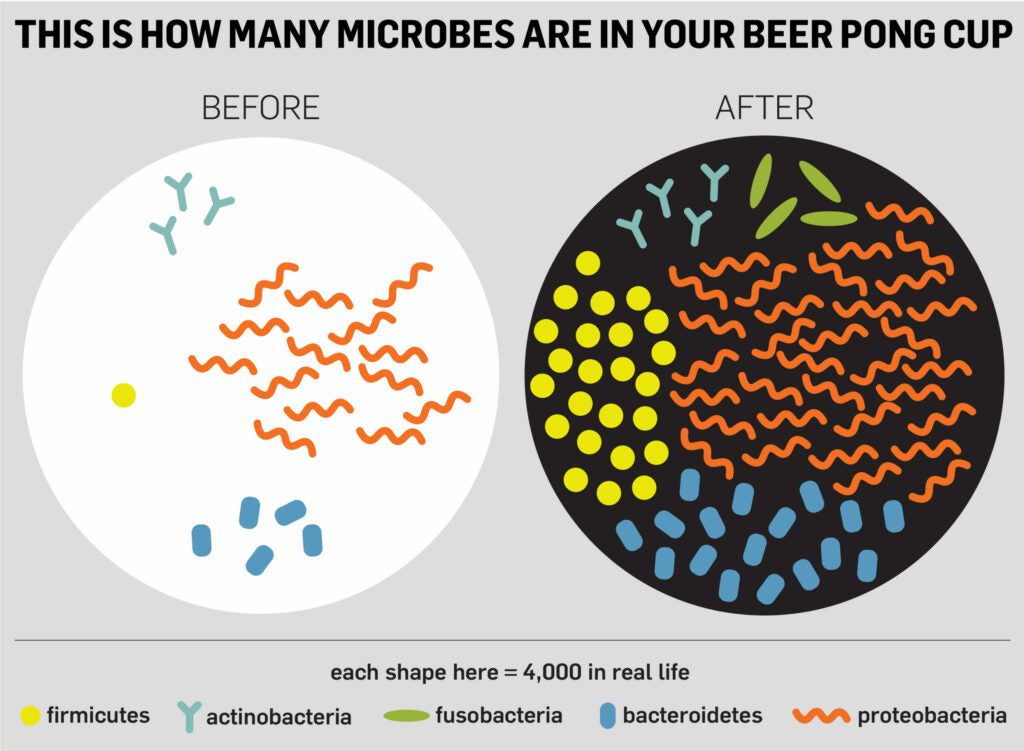
It’s difficult to know this for sure, however, because we sequenced the bacteria and didn’t put it in culture, says Georg Gerber, a pathology professor at Harvard Medical School and a Co-Director, Massachusetts Host-Microbiome Center. Sequencing alone can’t tell a pathologist if the bacteria we found are dead or capable of infecting people. But one type of microbe, called bacteroides, was concerning to Gerber. It appeared on one of the drinking cups after the game ended. “I find that a little weird because it’s an anaerobe found pretty much only in your gut,” he says. “That comes from fecal material. That’s the only one that’s a little gross.” Some species of bacteroides can cause infections if they end up in the body’s other tissues (usually this happens in a medical setting), but it’s impossible to tell from our analysis whether this was one of those species. And Gerber wasn’t sure that even infectious bacteroides would survive the acidic stomach anyway.
That old myth that the alcohol in the beer “cleans” the ball? It’s probably bogus. “Beer is something like 5 percent alcohol. That’s not going to kill much. In the lab we use 70 percent alcohol to sterilize surfaces,” Gerber says, though he adds that some studies have found that beer has unpredictable antiseptic properties likely tied to hops, which make the beer more flavorful and chemically stable.
The ping pong ball might still be transmitting disease, he adds—just not the kind you might pick up from the floor. “Probably the stuff on the floor is not what you’re so worried about—it’s the other people you’re playing with,” Gerber says. Viruses are the real menace here, since many of them can be passed easily between people and remain viable outside the body for long periods. It’s under conditions like these that nasty bugs like norovirus are easily transmitted between people; a sick person infecting the ball then throwing it into an opponent’s beer is more likely to make that opponent sick than if the ball was just carrying microbes from the floor or table.
Collecting samples
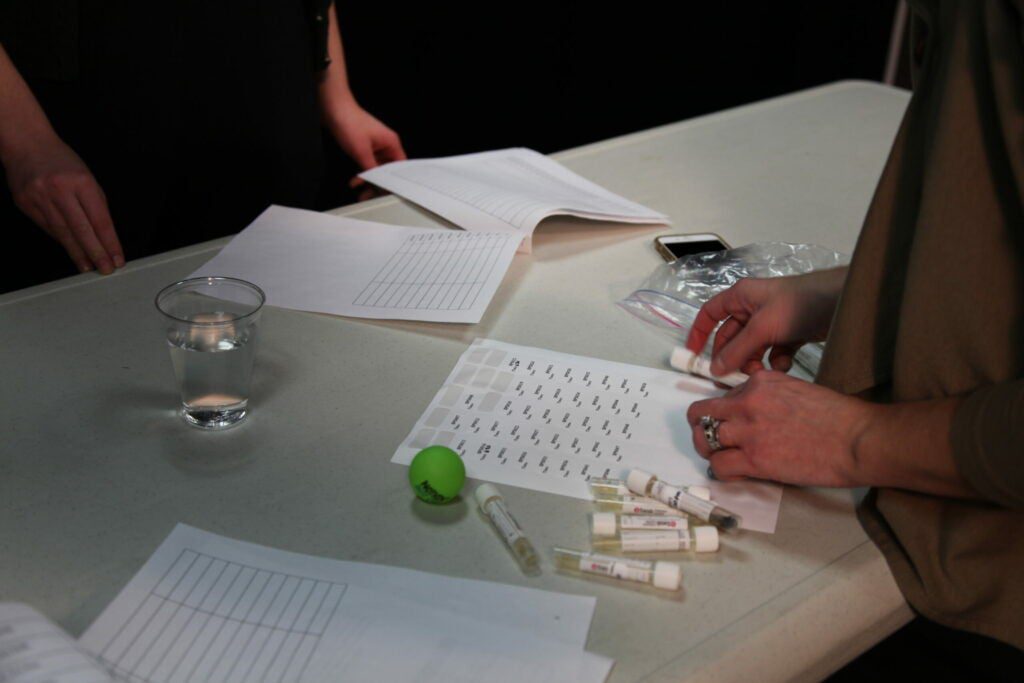
Keeping track
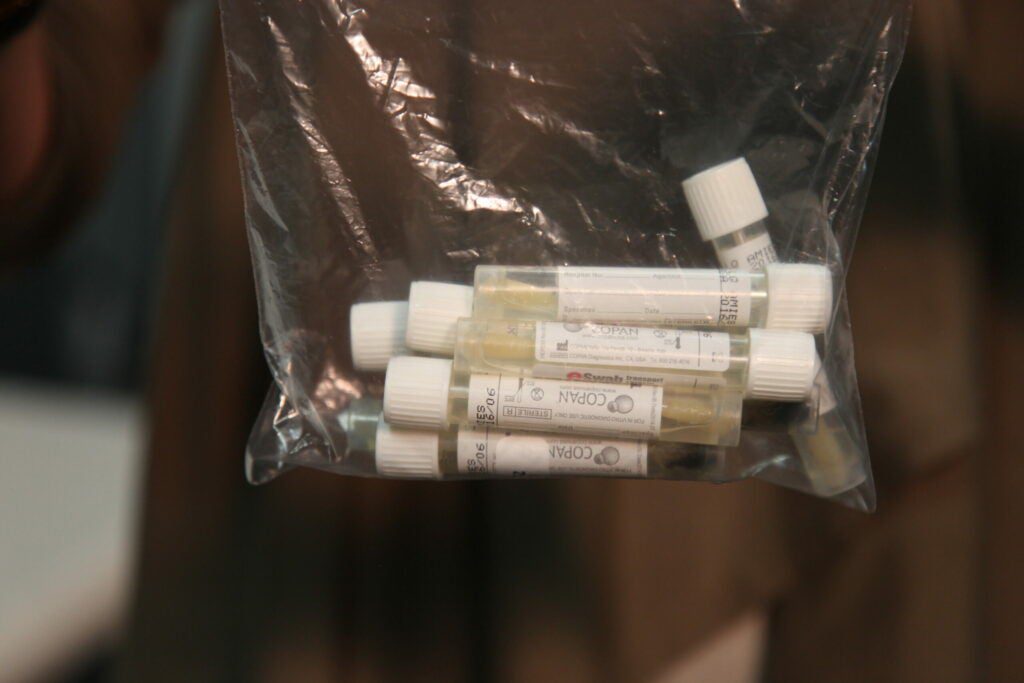
Collected samples
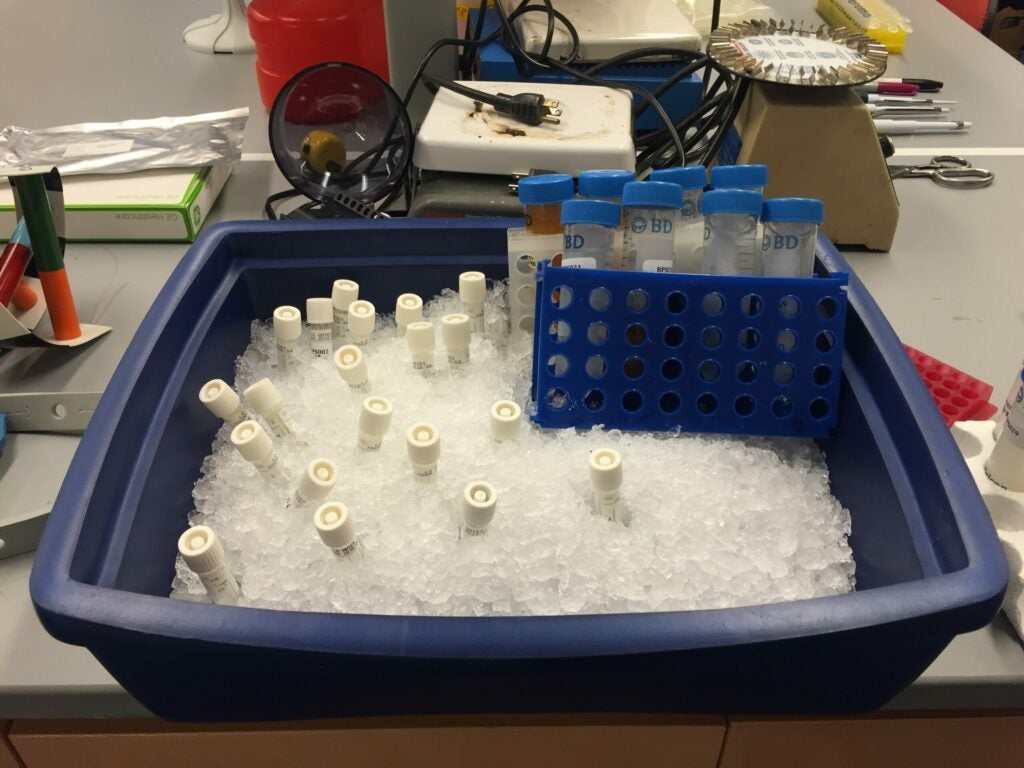
Samples on ice
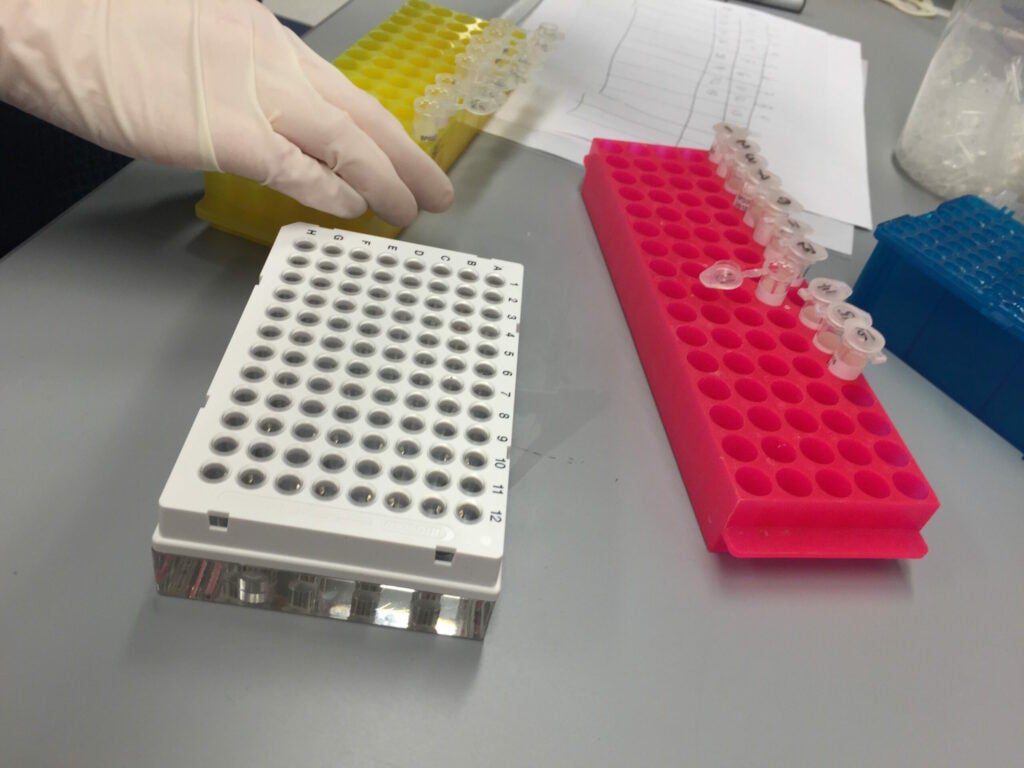
Prepping samples for sequencing
You should take all these findings with a grain of salt—our research probably wouldn’t be accepted by a peer-reviewed journal, Gerber says. We would need more trials to verify our findings, along with a control group (an untouched beer pong setup). Sequencing bacteria is not a reliable measure of pathogenicity—culturing the samples instead of trying to match their DNA to known species would have made it easier to understand if they were viable pathogens, Gerber says (remember that study that claimed the bubonic plague had been found on the New York City subway? Same issue.). Plus, he added, good scientists wouldn’t just look at the disease transmission risks of beer pong—they would also look at interventions intended to make the game more sanitary.
Luckily, he had a few suggestions. If you’re in college playing beer pong with a healthy immune system, Gerber says, you probably have nothing to worry about. And if you’re playing the game properly and not sharing cups, there shouldn’t be too many ways to transmit diseases between players. Still, if you want to make the game a little more sanitary, it’s not a bad idea to get all players to wash their hands, and to avoid teammates (and opponents) who’ve been looking sneezy or queasy.