




Close Menu
    What's Hot

    Child mental health forum to be held in Norristown

    May 13, 2024

    GameStop's stock prices surged when Roaring Kitty made a comeback on social media

    May 13, 2024

    Van Jones criticized possible Trump VP candidates for avoiding 2024 election questions, saying it's like failing kindergarten

    May 13, 2024
    Facebook X (Twitter) Instagram Telegram
    Facebook X (Twitter) Instagram
    The Plaza JournalThe Plaza Journal
    Subscribe
    Friday, January 30
    • Sports
      • American Football
      • Basketball
      • Baseball
      • Boxing
      • Cricket
      • Football
      • Hockey
      • Tennis
    • Politics

      John Dean believes the hush money case against Trump is very strong

      May 13, 2024

      “Cruel and unfeeling” Trump assistant boasts about causing innocent homeless people to be arrested

      May 13, 2024

      Only 5 percent of people mention January 6th as the most important memory from Trump's presidency: Survey

      May 13, 2024

      7 in 10 say they’ve given a lot of thought to election: Gallup

      May 13, 2024

      Trump: ‘Hannibal Lecter is a wonderful man’

      May 13, 2024
    • Technology
    • United States
    • United Kingdom
    • Business
    • Entertainment
    • Science
      1. Archaeology
      2. Anthropology
      3. Space
      4. Biology
      5. Ecology
      6. Geology
      7. Nanotechnology
      8. Neurology
      9. Paleontology
      10. Psychology
      11. Mathematics
      12. Geography
      13. Astrophysics
      14. Oceanography
      15. Physics
      Featured

      How perspiration and endurance helped humans become excellent runners and hunters

      Biology May 13, 20244 Mins Read
      Recent

      How perspiration and endurance helped humans become excellent runners and hunters

      May 13, 2024

      Amazing photos of colorful skies around the world as auroras shine in bright colors

      May 11, 2024

      Scotland has suddenly seen a large increase in mosquitoes

      May 10, 2024
    • Health
    Facebook X (Twitter) Instagram
    The Plaza JournalThe Plaza Journal
    Home»Environment

    Ocean life threatened by mass extinction as acidification rate nears 300 million year max

    By Tyrone JonesMarch 5, 2012 Environment 4 Mins Read
    Share
    Facebook Twitter LinkedIn Pinterest Email

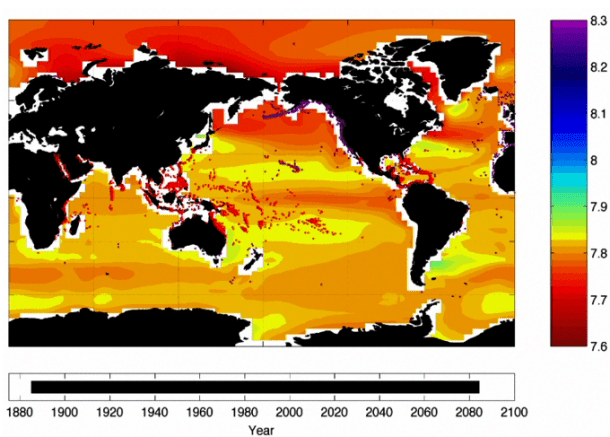
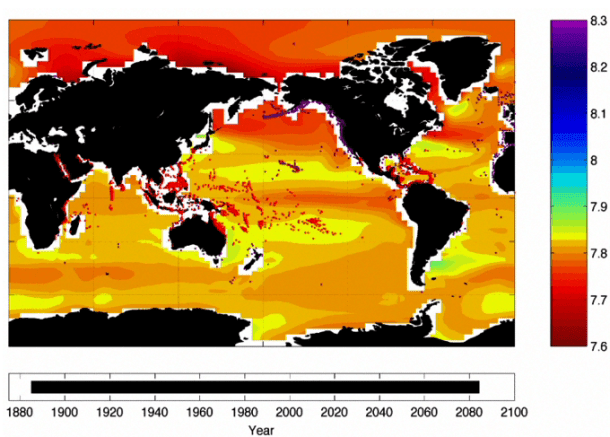
    A computer forecast of how the ocean pH will look in 2100 under emission scenarios. Purple dots show cold-water coral reefs. Red dots show warm-water coral reefs. The pH scale is shown on the right. (Credit: NOAA)
    A computer forecast of how the ocean pH will look in 2100 under emission scenarios. Purple dots show cold-water coral reefs. Red dots show warm-water coral reefs. The pH scale is shown on the right. (Credit: NOAA)

    A newly published paper in the journal Science provides a worrisome report – the world’s oceans are acidifying at a rate, which if set to continue, will be unprecedented in the last 300 million years. The scientists report that this comes as a direct consequence of the alarming ever increasing carbon dioxide concentration in the atmosphere, which also gets absorbed by the oceans, with dramatic effects on the marine ecosystem.

    To trace back the other periods of accelerated ocean acidification in Earth’s history, the scientists from the U.S. National Oceanic and Atmospheric Administration (NOAA) studied the isotopic composition of carbon changes found in marine rock samples. Rock records dating back as far as 300 million years were studied, which allowed tracking the ocean’s water pH over an impressive time frame. Thus, the researchers identified a number of key periods in Earth’s history when atmospheric CO2 concentration, and thus ocean water pH too, reached milestone levels. These spurred evolutionary changes, as well as  marine and animal extinction, like 65 million years ago when the dinosaurs died off.

    An interesting period was the Paleocene-Eocene Thermal Maximum (or PETM), dating back 56 million years ago, when an abrupt carbon dioxide release caused a global temperature increase of 6°C over 20,000 years. During PETM, the oceans became 0.4 units more acidic on the 14-point pH scale. This period marked the largest deep-sea extinction of foraminifera of the last 75 million years, and was one of the four biggest coral reef disasters of the last 300 million years. The study authors warn that what happened 56 million years ago was a fast warm-up and quick acidification, however when compared with the current rate of CO2 levels increase and water acidification since the start of the industrial age 150 years ago, we’re currently on a trend that will far out shadow it.

    Climate change comes in cycles, warming and cooling, and  the Earth has gone through a number of such periods during its history. It’s enough to compare some charts and time frames for relevancy to understand that there’s nothing really natural to what’s going on today on our planet, however. For instance, the first period the NOAA scientists decided to study was the end of the last ice, which started 18,000 years ago. Over a period of about 6,000 years, atmospheric CO2 levels increased by 30 percent, translating in a change of roughly 75 ppm – the same amount of increase was recorded in the past 50 years alone!

    “Ocean acidification may have severe consequences for marine ecosystems,” reads the study. “However, assessing its future impact is difficult because laboratory experiments and field observations are limited by their reduced ecologic complexity and sample period.”

    A similar report such as the from NOAA, was presented last summer at an U.N. conference. Then, the panel found that oceanic conditions are similar to those of “previous major extinctions of species in Earth’s history,” and that we face losing marine species and entire marine ecosystems, such as coral reefs, within a single generation.

    Over the past 150 years, the Earth’s oceans have become more acidic by 0.1 unit of pH, and the study’s scientists predict that by 2100 there will be an increase to 0.2 or 0.3 pH.

    “Given that the rate of change was an order of magnitude smaller compared to what we’re doing today, and still there were these big ecosystem changes, that gives us concern for what is going to happen in the future,” said Baerbel Hoenisch, one of the study’s lead authors.


    Carbon dioxide Eocene Global warming Paleocene
    Tyrone Jones

    Keep Reading

    Chicken fat supercapacitors may be able to store future green energy

    Aquatic activities near Kradan Island will be stopped to protect the coral

    On the intense front line of Thailand’s battle against smog

    The first ‘extreme’ solar storm in 20 years resulted in stunning auroras

    Add A Comment
    Leave A Reply Cancel Reply

    Must Read
    Latest Posts

    Child mental health forum to be held in Norristown

    May 13, 2024

    GameStop's stock prices surged when Roaring Kitty made a comeback on social media

    May 13, 2024

    Van Jones criticized possible Trump VP candidates for avoiding 2024 election questions, saying it's like failing kindergarten

    May 13, 2024

    Chicken fat supercapacitors may be able to store future green energy

    May 13, 2024

    Most students at prestigious universities believe that there is an issue with antisemitism, as per a survey conducted by U.S. News & World Report

    May 13, 2024
    The Plaza Journal White Logo
    X-twitter Facebook Google Pinterest Telegram

    News

    • World
    • US Politics
    • EU Politics
    • Business
    • Opinions
    • Connections
    • Science

    Company

    • Information
    • Advertising
    • Classified Ads
    • Contact Info
    • Do Not Sell Data
    • GDPR Policy
    • Media Kits

    The Plaza Journal

    • Contact Us
    • Subscription
    • Submit an Anonymous Tip
    • Newsletters
    • Sponsored News
    • Advertise With Us
    • Privacy Notice

    Keep updated

    Get the latest creative news from FooBar about art, design and business.

    Copyright © 2026 The Plaza Journal. All rights reserved.
    • Privacy Policy
    • Terms of Use
    • Cookie Policy
    • Accessibility

    Type above and press Enter to search. Press Esc to cancel.